5.2 - Recovery Equipment Categories
Module: Recovery Recycling Reclaiming Evacuation and Dehydration
Regulatory verification date: August 9, 2026
Primary authority: 40 CFR §§ 82.152 and 82.156 and current EPA Section 608 test-topic guidance
Course role: Distinguishes system-dependent recovery equipment from self-contained recovery equipment and explains how appliance components, refrigerant pressure, independent recovery mechanisms, and refrigerant charge affect equipment selection
Learning Objectives
After completing this section, a student should be able to:
- Define system-dependent recovery equipment and self-contained recovery equipment using the current Section 608 terminology.
- Explain how a system-dependent recovery method can rely on the appliance compressor, refrigerant pressure, or other appliance components.
- Explain how self-contained recovery equipment removes refrigerant without requiring assistance from components in the appliance.
- Distinguish the regulatory terms system-dependent and self-contained from the commonly used study terms passive and active.
- Apply the current 15-pound full-charge limitation on the use of system-dependent recovery equipment and recognize the permanent pump-out-unit exception.
- Select the more appropriate recovery-equipment category for representative appliance and operating-condition scenarios.
Introduction
Section 5.1 defined recovery as removing refrigerant from an appliance and storing it in an external container.
The next question is:
What provides the force that moves the refrigerant out of the appliance?
Section 608 recognizes two important recovery-equipment categories:
System-dependent recovery equipment
and:
Self-contained recovery equipment
The central difference is whether the recovery process depends on components in the appliance.
A system-dependent method requires assistance from the appliance.
A self-contained recovery machine is capable of removing refrigerant without requiring that assistance.
A useful first comparison is:
SYSTEM-DEPENDENT
Appliance helps move refrigerant
SELF-CONTAINED
Recovery equipment can move refrigerant independently
This distinction is especially important for:
- Small-appliance recovery.
- Appliances with functional or nonfunctional compressors.
- Equipment selection.
- Refrigerant-charge limitations.
- EPA 608 examination questions.
The terms also appear in older study material as passive recovery and active recovery. Those descriptions can be useful, but the current regulatory terms are system-dependent and self-contained.
Key Concepts
1. System-Dependent Recovery Equipment
Current Section 608 regulations define system-dependent recovery equipment as recovery equipment that requires assistance from components contained in the appliance to remove refrigerant.
The important word is:
requires
The recovery equipment cannot complete the intended recovery process independently of the appliance.
Depending on the appliance and recovery setup, the process may rely on:
- The appliance compressor.
- Refrigerant pressure.
- Pressure differences within the appliance.
- Other appliance components that help move refrigerant.
The basic concept is:
Appliance components or appliance conditions
+
recovery setup
→ refrigerant moves to external container
2. The Appliance Compressor Can Assist Recovery
When an appliance compressor is functional, it may be used as part of a system-dependent recovery process.
Conceptually:
Appliance compressor operates
→ refrigerant is moved through the appliance
→ refrigerant is directed toward the recovery container
In this arrangement, the compressor doing the refrigerant-moving work is the compressor inside the appliance.
Therefore, the recovery process depends on the appliance.
This differs from a self-contained recovery machine, which contains its own mechanism for moving refrigerant.
Exam clue: If the recovery process requires the appliance compressor to operate, the method is system-dependent.
3. Refrigerant Pressure Can Also Assist System-Dependent Recovery
System-dependent recovery does not always mean that the appliance compressor is running.
Refrigerant can also move because of:
- Pressure difference between the appliance and the recovery container.
- Refrigerant vapor pressure.
- Temperature-related pressure differences.
- Other appliance conditions that assist transfer.
Conceptually:
Higher pressure
→ lower pressure
can cause refrigerant to flow.
In this type of recovery, the external device does not provide an independent refrigerant compressor that can complete recovery without help from the appliance or its refrigerant condition.
The exact field procedure depends on:
- Appliance design.
- Refrigerant.
- Equipment instructions.
- Available service access.
- Compressor condition.
- Required recovery level.
Detailed small-appliance techniques are developed later in the Type I material.
4. Self-Contained Recovery Equipment
Current Section 608 regulations define self-contained recovery equipment as recovery and/or recycling equipment capable of removing refrigerant from an appliance without the assistance of components contained in the appliance.
The key idea is:
Recovery machine provides its own refrigerant-moving capability
A self-contained recovery machine commonly contains:
- Its own compressor, or
- Another independent refrigerant-moving mechanism.
The basic flow is:
Appliance
→ self-contained recovery machine
→ recovery cylinder
The appliance compressor does not have to perform the recovery work.
5. Independent Recovery Compressor
Many portable self-contained recovery machines use an internal compressor.
The recovery-machine compressor:
- Draws refrigerant from the appliance.
- Raises the refrigerant pressure as needed for transfer.
- Discharges the refrigerant toward the recovery cylinder.
This compressor is separate from the appliance compressor.
The distinction can be summarized as:
| Compressor Doing the Recovery Work | Equipment Category |
|---|---|
| Appliance compressor is required | System-dependent |
| Independent recovery-machine compressor performs the work | Self-contained |
Not every self-contained recovery device must use exactly the same mechanical design. The regulatory definition focuses on capability without assistance from appliance components, not on one required internal machine design.
6. Self-Contained Does Not Mean Self-Contained Appliance
The word self-contained can describe different things in HVAC.
Do not confuse:
Self-contained recovery equipment
with:
A self-contained packaged refrigeration or air-conditioning appliance
In this section, self-contained describes the recovery equipment, not the physical construction of the appliance being serviced.
A large field-installed system can be serviced using self-contained recovery equipment.
A small factory-sealed appliance can also be serviced using self-contained recovery equipment.
7. System-Dependent and Self-Contained Are Regulatory Terms
For EPA 608 purposes, the preferred terms are:
- System-dependent recovery equipment
- Self-contained recovery equipment
Older test-preparation material may also use:
- Passive recovery
- Active recovery
A common shorthand is:
System-dependent
≈ passive

Self-contained
≈ active
However, these should not be treated as perfect regulatory synonyms.
The safest examination approach is:
When a question uses the federal definitions, identify whether the recovery equipment requires assistance from the appliance or can recover without assistance from appliance components.
8. What “Passive” Usually Means
The word passive is commonly used in study material for recovery that depends on the appliance or existing refrigerant pressure rather than an independent recovery-machine compressor.
Examples may involve:
- Using the appliance compressor.
- Using the refrigerant’s own pressure.
- Using pressure differences to move refrigerant.
The word can help with memory:
Passive
→ recovery setup depends on system conditions
But the regulatory term to learn is:
System-dependent
9. What “Active” Usually Means
The word active is commonly used for a recovery machine that provides its own refrigerant-moving power.
A typical active recovery setup contains a separate recovery machine between the appliance and recovery cylinder.
The memory aid is:
Active
→ independent recovery machine does the work
But again, the current regulatory term is:
Self-contained recovery equipment
10. The Appliance Compressor Condition Matters
A system-dependent recovery method may depend strongly on whether the appliance compressor is functional.
If the appliance compressor is:
Functional
it may help push or circulate refrigerant during recovery.
If the appliance compressor is:
Nonfunctional
a recovery method that depended on that compressor can no longer use it.
This does not mean refrigerant may be vented.
Instead, the technician must use an appropriate recovery method and equipment capable of satisfying the applicable requirements.
Self-contained recovery equipment is especially useful because it does not require the appliance compressor to perform the refrigerant-removal work.
11. Refrigerant Pressure Changes During Recovery
At the beginning of recovery, refrigerant pressure may help move refrigerant.
As refrigerant is removed:
refrigerant mass decreases
→ system pressure may decrease
→ pressure-assisted flow may slow
Liquid refrigerant may also boil as pressure decreases.
This is one reason a system-dependent process can become slower or less effective as recovery continues.
A self-contained recovery machine can continue to create the pressure difference needed to draw refrigerant from the appliance, within the machine’s operating limits.
Detailed methods for increasing recovery speed are covered in Section 5.5 - Recovery Methods and Recovery Speed.
Technical and Regulatory Details
1. Current Regulatory Definitions
The current Section 608 definitions can be compared directly.
| Equipment Category | Current Regulatory Concept |
|---|---|
| System-dependent recovery equipment | Requires assistance from components contained in the appliance to remove refrigerant |
| Self-contained recovery equipment | Can remove refrigerant from the appliance without assistance from components contained in the appliance |
The distinction is based on:
Does the recovery process require help from appliance components?
If:
YES
→ System-dependent
If:
NO
→ Self-contained
2. System-Dependent Recovery Energy Sources
A system-dependent method can use one or more sources of refrigerant-moving force.
Appliance Compressor
Appliance compressor
→ compresses / moves refrigerant
→ refrigerant exits appliance
The recovery depends directly on a working component of the appliance.
Refrigerant Pressure
Refrigerant vapor pressure
+
pressure difference
→ refrigerant flows toward lower pressure
The process depends on the refrigerant condition and recovery arrangement.
Appliance Configuration
Valves, receivers, access points, and other components can affect where refrigerant is located and how it can be moved.
Therefore:
System-dependent recovery is not one single hookup. It is a category defined by dependence on the appliance.
3. Self-Contained Recovery Energy Source
A self-contained recovery machine supplies its own refrigerant-moving capability.
A common arrangement is:
Appliance
↓
Recovery hose
↓
Self-contained recovery machine
↓
Recovery hose
↓
Recovery cylinder
The independent recovery machine may have:
- Compressor.
- Condenser.
- Fan.
- Controls.
- Pressure protection.
- Filter or inlet protection.
- Separate liquid and vapor operating procedures.
Specific equipment features vary by model.
Always follow the recovery-machine manufacturer’s instructions.
4. Current 15-Pound Limitation
Current federal regulations state that system-dependent recovery equipment may not be used with an appliance having a full charge of more than 15 pounds of refrigerant, unless the system-dependent equipment is permanently attached to the appliance as a pump-out unit.
The rule can be summarized as:
Full charge ≤ 15 lb
→ system-dependent equipment may be used when otherwise appropriate
Full charge > 15 lb
→ system-dependent equipment may NOT be used
except:
Permanently attached pump-out unit
→ specific exception
5. “Full Charge” Is the Controlling Quantity
The 15-pound limitation is based on the appliance’s full charge.
Do not substitute:
- The amount currently remaining in a leaking appliance.
- The amount expected to be recovered.
- The quantity already removed.
- The amount in one isolated hose.
Example:
Appliance full charge = 20 lb
Current refrigerant remaining = 8 lb
This is still an appliance with a full charge greater than 15 lb.
The ordinary system-dependent equipment limitation therefore still applies.
Exam trap: A leak that reduces the amount currently in the system does not change the appliance’s full-charge classification for this rule.
6. Permanent Pump-Out Unit Exception
The current regulation contains a specific exception:
System-dependent equipment may be used on an appliance with a full charge greater than 15 pounds when the system-dependent equipment is permanently attached to the appliance as a pump-out unit.
A pump-out unit may be designed as part of a system so that refrigerant can be moved into:
- A receiver.
- Another isolated portion of the appliance.
- Another appropriate storage location associated with the appliance.
Do not generalize this exception to portable system-dependent recovery devices.
The key words are:
permanently attached
and:
pump-out unit
7. Owner-Only Pump-Out Equipment Provision
Current regulations also contain a specialized provision for persons who maintain, service, repair, or dispose of only appliances that they own and that contain pump-out units.
Those persons are exempt from the requirement to use certified self-contained recovery and/or recycling equipment.
This is a narrow regulatory provision.
It does not mean:
- Any owner may vent refrigerant.
- Any owner may ignore evacuation requirements.
- Any temporary hookup becomes a pump-out unit.
- A service contractor may ignore equipment requirements.
Detailed recovery-equipment certification requirements are developed in Section 5.3 - Recovery Equipment Certification and Service Fittings.
8. Small Appliances and System-Dependent Equipment
A Section 608 small appliance contains 5 pounds or less of refrigerant and satisfies the complete factory-manufactured, factory-charged, and factory-sealed definition.
Because a small appliance cannot exceed 5 pounds under that definition, its full charge is below the 15-pound system-dependent threshold.
Therefore, system-dependent recovery is especially relevant to Type I small-appliance service.
However, the technician must still satisfy:
- Applicable recovery requirements.
- Equipment-certification requirements.
- Manufacturer instructions.
- Refrigerant-handling requirements.
- Venting prohibition.
- Safety requirements.
The required small-appliance recovery performance is developed in Section 5.3 and revisited in the Type I module.
9. Appliances Above 15 Pounds
For an appliance with a full charge greater than 15 pounds, the normal field recovery approach requires appropriate self-contained recovery and/or recycling equipment unless the specific permanent pump-out-unit exception applies.
Examples may include:
- Many residential and commercial split systems.
- Rooftop units.
- Commercial refrigeration equipment.
- Larger packaged equipment.
- Industrial refrigeration systems.
Do not classify equipment only from appearance.
The actual full charge and equipment configuration control.
10. Recovery Equipment Must Match the Application
Choosing between system-dependent and self-contained equipment is not based only on convenience.
Consider:
- Appliance full charge.
- Appliance compressor condition.
- Refrigerant.
- Appliance pressure classification.
- Available service access.
- Required final recovery condition.
- Equipment certification and refrigerant compatibility.
- Recovery-machine operating limits.
- Manufacturer instructions.
The recovery-equipment category is only one part of equipment selection.
11. Self-Contained Equipment Does Not Eliminate the Need for Correct Procedures
A self-contained recovery machine can remove refrigerant without appliance-component assistance, but improper use can still cause:
- Excessive discharge pressure.
- Refrigerant release.
- Cross-contamination.
- Liquid slugging of the recovery machine.
- Cylinder overfill.
- Equipment damage.
- Unsafe operation.
The technician must still:
identify refrigerant
→ select correct equipment
→ select correct recovery cylinder
→ connect correctly
→ monitor pressures and cylinder capacity
→ reach the required recovery condition
Later Module 5 sections develop these procedures.
System-Dependent and Self-Contained Recovery Compared
| Feature | System-Dependent | Self-Contained |
|---|---|---|
| Federal definition | Requires assistance from appliance components | Can remove refrigerant without appliance-component assistance |
| Common study shorthand | Passive | Active |
| Appliance compressor may be used | Yes | Not required |
| Refrigerant pressure may assist transfer | Yes | May assist, but is not required for capability |
| Independent recovery-machine compressor | Generally no | Commonly yes |
| Depends on appliance condition | More strongly | Less strongly |
| Can be affected by failed appliance compressor | Yes | Recovery-machine operation does not require appliance compressor |
| Ordinary use when full charge is over 15 lb | No | Yes, when equipment is otherwise appropriate |
| Specific >15-lb exception | Permanently attached pump-out unit | Not needed for this limitation |
| Common association in EPA 608 study | Type I / small-appliance recovery | Broad field recovery applications |
Important Qualification
The table gives the equipment-category distinction.
It does not by itself establish that a particular machine is:
- Certified for a specific refrigerant.
- Suitable for a flammable refrigerant.
- Properly rated for a pressure category.
- Appropriate for every appliance.
- Capable of meeting every required evacuation level.
Those issues are addressed in Section 5.3 and later equipment-specific modules.
Equipment-Selection Decision Process
Step 1 - Determine the Appliance Full Charge
Ask:
Is the full charge more than 15 lb?
If yes:
portable system-dependent recovery
→ not permitted
unless the equipment falls under the specific permanent pump-out-unit provision.
Step 2 - Check Appliance Compressor Condition
If a proposed system-dependent method requires the appliance compressor, determine whether that compressor is functional.
If it is not functional:
do not rely on it
Select another permitted recovery arrangement.
Step 3 - Determine Whether the Recovery Equipment Can Operate Independently
Ask:
Can this recovery equipment remove refrigerant
without assistance from components in the appliance?
If yes:
Self-contained
If no:
System-dependent
Step 4 - Confirm Equipment Compatibility
Confirm the equipment is suitable for:
- Refrigerant.
- Pressure.
- Appliance category.
- Required recovery level.
- Applicable refrigerant safety classification.
Step 5 - Follow Manufacturer Instructions
Current Section 608 requirements state that recovery and recycling equipment must be used according to the manufacturer’s directions unless those directions conflict with the federal requirements.
Representative Scenarios
| Scenario | Correct Interpretation |
|---|---|
| Appliance compressor must run to push refrigerant into a recovery container | System-dependent recovery |
| Refrigerant moves primarily because of appliance pressure and pressure difference | System-dependent recovery |
| Portable recovery machine uses its own compressor to draw refrigerant from the appliance | Self-contained recovery |
| Appliance compressor has failed, but an independent recovery machine continues to remove refrigerant | Self-contained recovery |
| Appliance has a full charge of 10 lb and compatible system-dependent equipment is proposed | The 15-lb prohibition does not by itself prevent system-dependent use |
| Appliance has a full charge of 20 lb but has leaked down to 8 lb | Ordinary portable system-dependent equipment is still prohibited because full charge exceeds 15 lb |
| Appliance has a full charge of 30 lb and a permanently attached system pump-out unit | The specific permanent pump-out-unit exception may apply |
| Technician calls every system-dependent method “passive” | Useful shorthand, but system-dependent is the regulatory term |
| Technician calls every machine with a motor “self-contained” | Incomplete reasoning; the definition depends on whether it can remove refrigerant without appliance-component assistance |
| Self-contained recovery machine is connected to an appliance | The appliance compressor does not need to provide the recovery force |
Important Terms
Active Recovery
Active recovery is a common study and industry term for recovery using equipment that provides its own refrigerant-moving force.
For regulatory questions in this course, use the more precise term self-contained recovery equipment.
Appliance Compressor
The appliance compressor is the compressor that is part of the refrigeration or air-conditioning appliance itself.
When this compressor is required to move refrigerant during recovery, the recovery arrangement is system-dependent.
Full Charge
Full charge is the quantity of refrigerant required for normal operating characteristics and conditions of the appliance, as applicable under the Section 608 framework.
The system-dependent recovery limitation uses the appliance’s full charge, not simply the amount of refrigerant currently remaining.
Passive Recovery
Passive recovery is a common study term for a recovery process that depends on the appliance, refrigerant pressure, or system conditions rather than an independent recovery-machine compressor.
The current regulatory term is system-dependent recovery equipment.
Pump-Out Unit
A pump-out unit is recovery equipment associated with an appliance that can be used to transfer refrigerant for service or repair.
The specific Section 608 exception discussed in this section applies when system-dependent equipment is permanently attached to the appliance as a pump-out unit.
Recovery Machine
A recovery machine is equipment used to remove refrigerant from an appliance for storage in an external container or other permitted location.
Self-Contained Recovery Equipment
Self-contained recovery equipment is refrigerant recovery and/or recycling equipment capable of removing refrigerant from an appliance without assistance from components contained in the appliance.
System-Dependent Recovery Equipment
System-dependent recovery equipment is refrigerant recovery equipment that requires assistance from components contained in the appliance to remove refrigerant.
System Receiver
A system receiver is an isolated portion of an appliance, or a vessel within the appliance, used to hold the refrigerant charge during service or repair.
It is part of the appliance and is different from an external recovery cylinder.
Figures and Diagrams
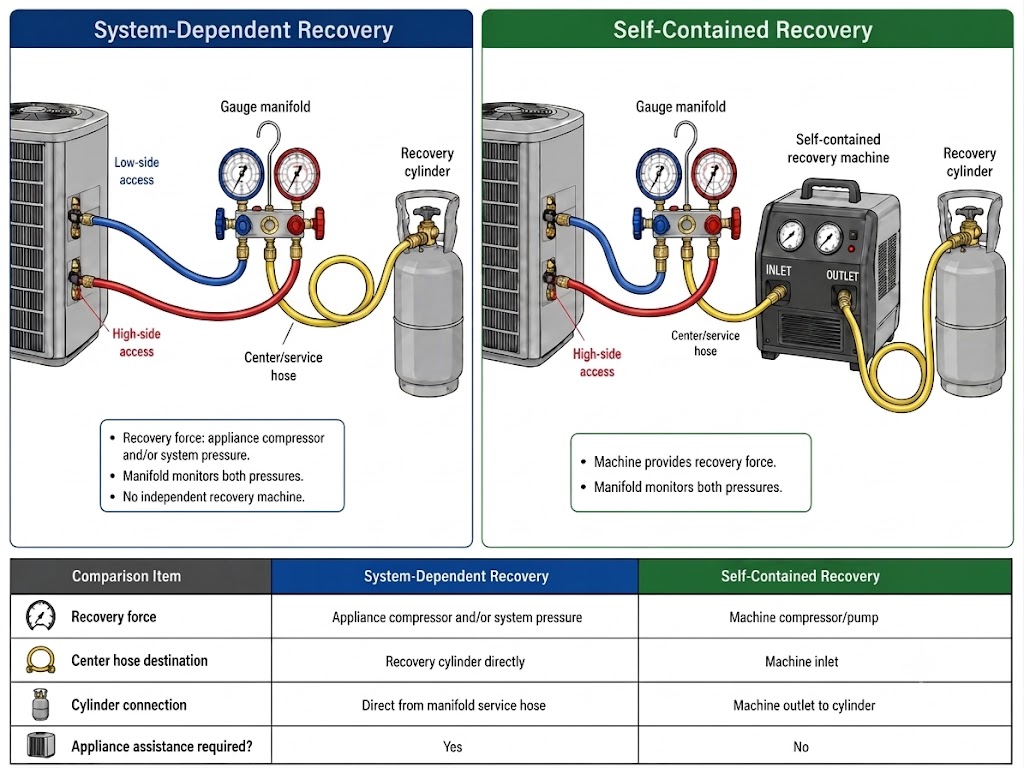
Figure 5.2.1 – System-dependent and self-contained refrigerant-recovery equipment.
AI-generated instructional figure: It may contain visual inaccuracies. Use the accompanying lesson text and cited authoritative sources to verify technical and regulatory details.
Figure 5.2.1 should reinforce one central question:
Where does the force for refrigerant recovery come from?
For system-dependent recovery, the appliance or its refrigerant condition provides necessary assistance.
For self-contained recovery, the external recovery equipment can perform the removal without requiring appliance-component assistance.
EPA 608 Exam Focus
What Students Must Remember
- System-dependent recovery equipment requires assistance from components in the appliance.
- Self-contained recovery equipment can remove refrigerant without assistance from appliance components.
- A functional appliance compressor can be used as part of system-dependent recovery.
- Refrigerant pressure or pressure difference may also help drive system-dependent recovery.
- A self-contained recovery machine commonly provides its own compressor or other independent refrigerant-moving mechanism.
System-dependentis commonly associated with the study term passive.Self-containedis commonly associated with the study term active.- For regulatory questions, use the exact terms system-dependent and self-contained.
- Current federal rules prohibit use of system-dependent equipment on an appliance with a full charge greater than 15 lb, unless it is permanently attached as a pump-out unit.
- The 15-lb rule uses the full charge, not the amount currently remaining after a leak.
- A failed appliance compressor can prevent a recovery method that depends on that compressor from working as intended.
- A self-contained recovery machine does not require the appliance compressor to do the recovery work.
- A recovery cylinder stores refrigerant; it is not itself the recovery machine.
- A vacuum pump is not a substitute for a refrigerant recovery machine.
- Recovery equipment must be used according to manufacturer instructions unless those instructions conflict with federal requirements.
High-Priority Memory Aid
SYSTEM-DEPENDENT
→ Appliance helps

SELF-CONTAINED
→ Recovery machine can work independently
And:
Full charge > 15 lb
→ no ordinary system-dependent recovery equipment

Exception:
permanently attached pump-out unit
Typical Exam Question Patterns
Students may be asked to:
- Define system-dependent recovery equipment.
- Define self-contained recovery equipment.
- Identify which method requires the appliance compressor.
- Identify which method uses an independent recovery-machine compressor.
- Interpret
passiveas system-dependent terminology. - Interpret
activeas self-contained terminology. - Identify how refrigerant pressure can assist system-dependent recovery.
- Determine whether system-dependent equipment may be used based on appliance full charge.
- Recognize the 15-pound threshold.
- Recognize the permanent pump-out-unit exception.
- Distinguish full charge from the amount currently remaining.
- Determine which method remains usable when the appliance compressor is nonfunctional.
- Distinguish a recovery machine from a recovery cylinder.
- Distinguish a recovery machine from a vacuum pump.
High-Priority Comparison Table
| Exam Clue | Most Likely Answer |
|---|---|
| Requires appliance components | System-dependent |
| Appliance compressor required for recovery | System-dependent |
| Refrigerant pressure drives transfer | System-dependent |
| Commonly called passive | System-dependent |
| Works without appliance-component assistance | Self-contained |
| Separate recovery-machine compressor | Self-contained |
| Commonly called active | Self-contained |
| Appliance compressor has failed but separate machine performs recovery | Self-contained |
| Full charge = 20 lb, portable system-dependent equipment | Not permitted |
| Current remaining charge = 8 lb but full charge = 20 lb | Still subject to >15-lb prohibition |
| >15 lb with permanently attached pump-out unit | Specific exception may apply |
Common Mistakes and Confusing Points
Mistake 1: Assuming System-Dependent Means No Equipment Is Used
System-dependent recovery can still use hoses, valves, containers, and other recovery equipment.
The defining point is that refrigerant removal requires assistance from components in the appliance.
Mistake 2: Assuming System-Dependent Always Means the Appliance Compressor Must Run
The appliance compressor is one important source of assistance.
System-dependent recovery can also depend on refrigerant pressure or other appliance conditions.
Mistake 3: Assuming Self-Contained Means the Appliance Is a Packaged Unit
Self-contained describes the recovery equipment, not whether the appliance is packaged or field assembled.
Mistake 4: Treating Passive and Active as the Primary Federal Definitions
The regulatory terms are:
System-dependent
Self-contained
Passive and active are useful study shorthand.
Mistake 5: Applying the 15-Pound Rule to the Refrigerant Remaining After a Leak
The rule uses the appliance’s full charge.
An appliance designed for a 20-pound full charge does not become eligible for ordinary system-dependent recovery merely because only 8 pounds remain.
Mistake 6: Forgetting the Permanent Pump-Out-Unit Exception
The >15-pound prohibition has a specific exception for system-dependent equipment permanently attached to the appliance as a pump-out unit.
Do not broaden the exception to temporary portable equipment.
Mistake 7: Assuming a Recovery Cylinder Is a Self-Contained Recovery Machine
A recovery cylinder stores refrigerant.
It does not by itself provide the refrigerant-moving mechanism required for self-contained recovery.
Mistake 8: Using a Vacuum Pump as Though It Were a Recovery Machine
A vacuum pump is used for evacuation and dehydration after refrigerant has been recovered to the applicable level.
It is not the normal substitute for a certified refrigerant recovery machine.
Mistake 9: Assuming Self-Contained Equipment Can Be Used Without Checking Compatibility
A separate recovery machine must still be suitable for the refrigerant, pressure, appliance type, and applicable safety requirements.
Mistake 10: Assuming a Failed Appliance Compressor Allows Venting
A failed compressor changes recovery technique.
It does not remove the obligation to recover refrigerant properly.
Concept-Check Questions
Question 1
Which statement best defines system-dependent recovery equipment?
A. Equipment that requires assistance from components in the appliance to remove refrigerant
B. Equipment that always contains its own independent compressor
C. A recovery cylinder that stores refrigerant after reclamation
D. A vacuum pump used only for dehydration
Question 2
Which statement best defines self-contained recovery equipment?
A. Equipment that can recover refrigerant only while the appliance compressor is running
B. Equipment that can remove refrigerant from an appliance without assistance from components contained in the appliance
C. Equipment installed only in factory-sealed small appliances
D. A cylinder with separate liquid and vapor valves
Question 3
A technician uses the operating compressor inside an appliance to help move refrigerant to an external recovery container. Which recovery category is being used?
A. Reclamation
B. Self-contained recovery
C. System-dependent recovery
D. Evacuation
Question 4
A portable recovery machine uses its own compressor to remove refrigerant while the appliance compressor remains off. Which category best describes the recovery machine?
A. System-dependent
B. Self-contained
C. System receiver
D. Passive storage
Question 5
An appliance has a full charge of 20 pounds but has leaked until only about 8 pounds remain. May ordinary portable system-dependent recovery equipment be used solely because less than 15 pounds currently remain?
A. Yes, because current refrigerant quantity always controls the rule.
B. Yes, if the refrigerant is vapor.
C. No, because the limitation is based on the appliance’s full charge.
D. No, because system-dependent equipment is prohibited on every appliance.
Question 6
What is the specific exception to the ordinary prohibition on using system-dependent recovery equipment with an appliance having a full charge greater than 15 pounds?
A. The appliance compressor is functional.
B. The system-dependent equipment is permanently attached to the appliance as a pump-out unit.
C. The refrigerant cylinder is chilled.
D. The technician holds Universal certification.
Question 7
Which pairing is most useful as study shorthand, while remembering that the federal definitions use different terminology?
A. System-dependent ≈ passive; self-contained ≈ active
B. System-dependent ≈ reclaim; self-contained ≈ recycle
C. System-dependent ≈ high side; self-contained ≈ low side
D. System-dependent ≈ vacuum; self-contained ≈ pressure
Question 8
Which statement correctly revisits the recovery definition from Section 5.1?
A. Recover means to manufacture new refrigerant.
B. Recover means to remove refrigerant from an appliance and store it in an external container without necessarily processing it.
C. Recover means to verify refrigerant purity to reclamation specifications.
D. Recover means to intentionally release refrigerant after measuring its pressure.
Answers and detailed explanations will be provided in
5.12 - Answers and Explanations.md.
Section Summary
Section 608 distinguishes recovery equipment by whether the appliance must assist the refrigerant-removal process.
System-dependent recovery equipment
→ requires assistance from appliance components
Assistance may include:
- Appliance compressor operation.
- Refrigerant pressure.
- Pressure differences.
- Other appliance components or conditions.
By contrast:
Self-contained recovery equipment
→ can remove refrigerant without appliance-component assistance
A self-contained recovery machine commonly uses its own compressor or other independent refrigerant-moving mechanism.
Study material often uses:
System-dependent ≈ passive
Self-contained ≈ active
but the current regulatory terms should be used when precision matters.
The major equipment-use limitation is:
Appliance full charge > 15 lb
→ system-dependent equipment ordinarily prohibited
with the specific exception:
system-dependent equipment permanently attached
as an appliance pump-out unit
The threshold depends on full charge, not merely the amount of refrigerant remaining at the time of service.
The next section explains how recovery and recycling equipment is certified, which equipment standards apply, and how service fittings and access points affect compliant refrigerant handling.
See Section 5.3 - Recovery Equipment Certification and Service Fittings.
References
Current Regulatory and EPA Sources
-
Electronic Code of Federal Regulations, 40 CFR § 82.152 — Definitions, accessed August 9, 2026.
-
Electronic Code of Federal Regulations, 40 CFR § 82.156 — Proper Evacuation of Refrigerant from Appliances, accessed August 9, 2026.
-
U.S. Environmental Protection Agency, Section 608 Test Topics, accessed August 9, 2026.
-
U.S. Environmental Protection Agency, Stationary Refrigeration Service Practice Requirements, accessed August 9, 2026.
-
U.S. Environmental Protection Agency, Refrigerant Recovery and Recycling Equipment Certification, accessed August 9, 2026.
Supplemental EPA Terminology Source
- U.S. Environmental Protection Agency, archived Section 608 Technician Certification Test Topics, Type I recovery material using
system-dependent ("passive") recovery deviceterminology. This archived terminology is used only to explain the commonpassivestudy term; current eCFR definitions control the regulatory wording.